Event 2 of 7 · Lan Xang, the kingdom of a million elephants · 1560
King Setthathirath moves the capital to Vientiane
In 1560 King Setthathirath finished Wat Xieng Thong in Luang Prabang and moved the capital of Lan Xang down the Mekong to Vientiane, where he built the Haw Phra Kaew and the great stupa of That Luang.
Why move the capital?
Setthathirath, born in 1534, became king of Lan Xang in 1548. Luang Prabang lay in a narrow valley between mountains; Vientiane sat on a wide, fertile plain that could feed a much larger city and controlled the river trade of the middle Mekong.
There was also danger: in the 1550s armies from the west were conquering kingdom after kingdom, and a capital further down the river was easier to defend and to supply.
Luang Prabang keeps the Pha Bang
Before leaving, the king completed Wat Xieng Thong, the royal temple by the meeting of the rivers, with its sweeping roofs. The old capital kept the Pha Bang Buddha and from then on was called Luang Prabang, 'the royal city of the Pha Bang'.
A new capital on the plain
In Vientiane Setthathirath built city walls and a palace. In 1565 he raised the Haw Phra Kaew to house the Emerald Buddha, which he had brought with him when he returned to rule Lan Xang, and in 1566 he rebuilt Pha That Luang as the great golden stupa that now appears on the national emblem.
Defending the kingdom
In 1565 an army from Pegu took the new capital. The king withdrew into the forests, harried the occupiers and returned when they left; Lan Xang kept its independence.
Setthathirath died in 1571 during a campaign in the far south, and the place of his death has never been found. A statue of him stands in front of That Luang.
Points on the route (2)
- 1
Luang Prabang — Wat Xieng Thong (1560)
Luang Prabang: the king completes Wat Xieng Thong in 1560. The old capital keeps the Pha Bang and its new name.
- 2
Vientiane — new capital, That Luang (1566)
Vientiane: the new capital, with city walls, the Haw Phra Kaew (1565) and the golden stupa of That Luang (1566).

Follow it today
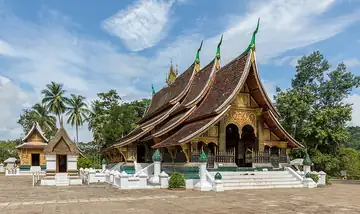 1Wat Xieng ThongວັດຊຽງທອງLuang PrabangThe royal temple of Luang Prabang, with sweeping roofs and a glittering “tree of life” mosaic.
 12Haw Phra Kaewຫໍພະແກ້ວVientianeThe royal temple built in 1565 for the Emerald Buddha, now a museum of Lao Buddhist art.
 11Pha That LuangພະທາດຫຼວງVientianeThe great golden stupa of Vientiane and the national symbol of Laos.
 21That SikhottabongພະທາດສີໂຄດຕະບອງKhammouaneThe most sacred stupa of central Laos, on the Mekong bank south of Thakhek — about 29 m tall, with a gilded spire.
 24That Ing HangພະທາດອິງຮັງSavannakhetThe holiest stupa of Savannakhet: a richly carved, 9-metre stupa said to hold a relic of the Buddha's spine.
What historians still debate
- The year of the move is given as 1560 in some sources and 1563 in others; the court may have moved in stages.
- How Setthathirath died in 1571 is unknown. The chronicles say he disappeared during a campaign in the south, and some later stories link his end to the Attapeu region.
Questions people ask
Why is it called Luang Prabang?
Because the city kept the Pha Bang Buddha when the capital moved to Vientiane: Luang Prabang means 'the royal city of the Pha Bang'.
Is the Emerald Buddha still in Vientiane?
No. It was carried off in 1779 and never returned. The Haw Phra Kaew that housed it is now a museum of Buddhist art.
Can I see both capitals in one trip?
Yes. Wat Xieng Thong in Luang Prabang and Haw Phra Kaew and That Luang in Vientiane all date from Setthathirath's reign; the train between the two cities takes about two hours.
Sources
Camps and routes are placed from historical records and memorials; positions are approximate. · Open in Google Maps ↗